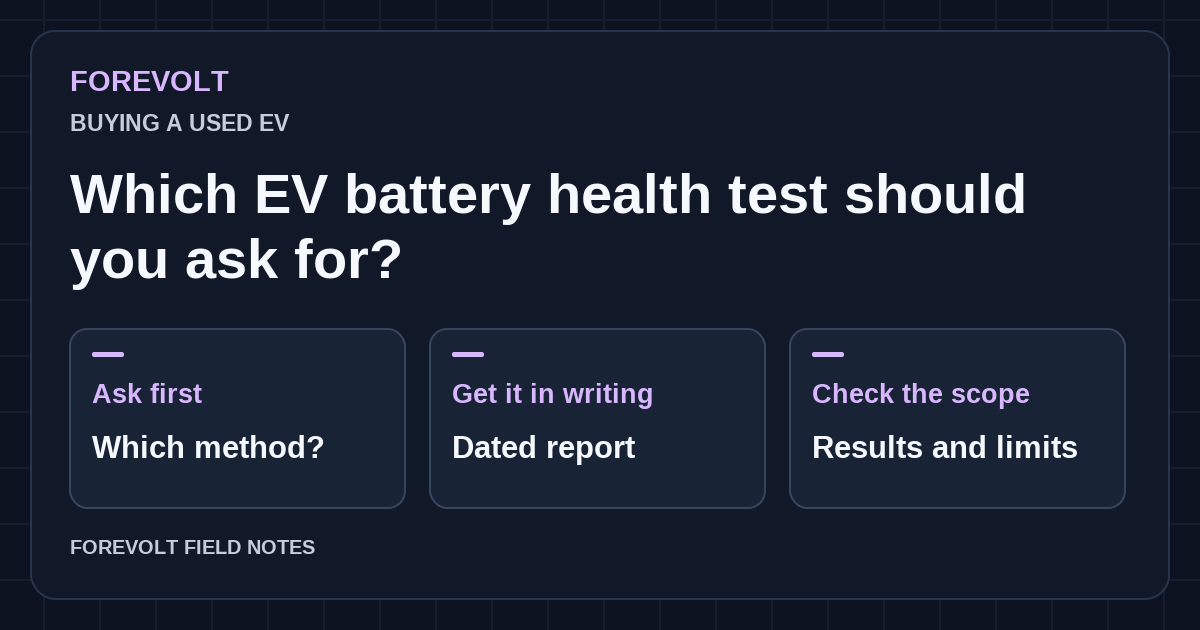
The words “battery test” can describe very different things. One seller may mean a screenshot, another a technician’s diagnostic report, and another a measurement made while the car is driven through a defined discharge. Before comparing percentages, find out how each number was produced.
Three things that are often called a battery test
- Dashboard or vehicle-system reading: a range display is not a capacity test. Some cars or diagnostic devices can show a battery-management estimate instead. Ask precisely what value the tool is reporting.
- Quick diagnostic: a tool reads vehicle signals and may use a model to estimate health or identify abnormalities. Investigate which checks are included. The speed of the check alone does not tell you what it can measure.
- Discharge-based assessment: the procedure follows energy delivered through a specified part of a discharge. It still needs a reference capacity and an explained test window. It may take more effort than a stationary scan.
Diagnostic providers can offer more than one method. For example, AVILOO’s technical note on capacity assessment describes how it determines removable energy during its PREMIUM procedure. Its certification information also explains that its system uses vehicle data and analytical models. Those are descriptions of one provider, not a standard that all certificates follow.
When the extra detail is useful
A quick report may be a useful first check if it identifies the car and the method clearly. A more detailed assessment is particularly worth discussing when two reports disagree, the result sits close to a warranty threshold, or you are choosing between cars at a meaningful price difference. Before relying on the result for a warranty claim, ask the warrantor which procedure it accepts.
Give the tester a precise brief
Ask for a report matching the exact vehicle and pack, with the test date and mileage, the method and capacity reference, and any conditions or limitations that affect interpretation. Ask whether the report covers faults as well as capacity, and how it handles a replacement battery. If it does not give you a defensible basis for a comparison, keep that uncertainty in the buying decision rather than turning the percentage into a pass/fail score.