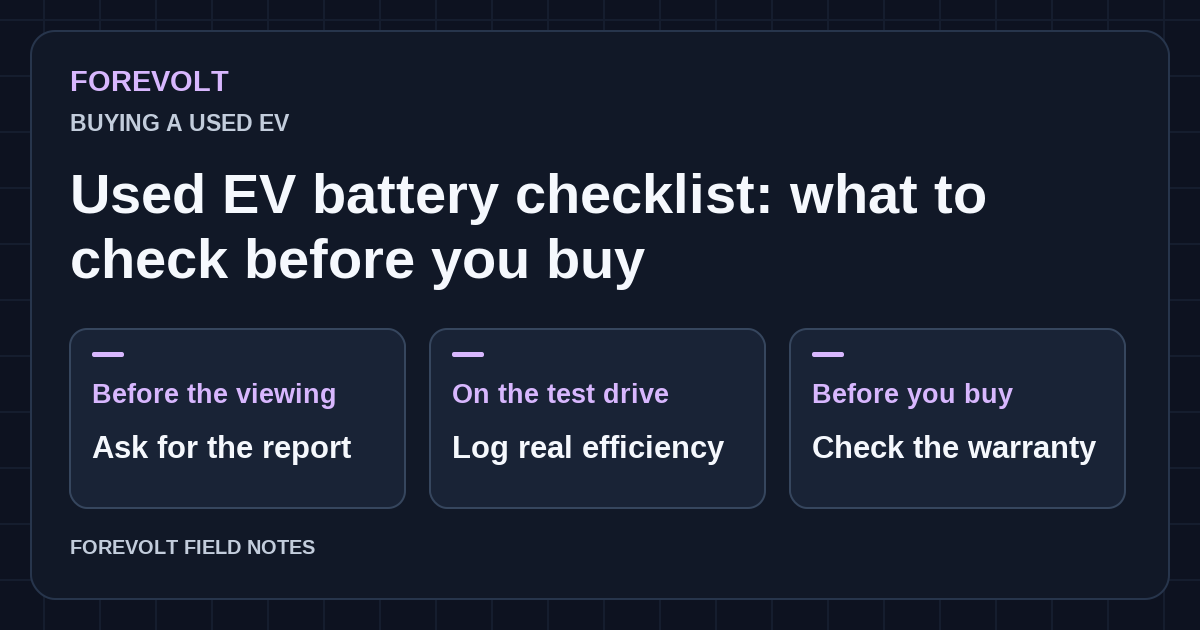
You don’t need to understand battery chemistry to buy a used electric car. You do need to separate three questions: does the battery report belong to this car, can the car cover your usual journeys, and what would you do if the battery developed a fault? Here’s how to get answers before committing.
Before the viewing: ask for the paperwork
- Get the exact model and battery version. Ask for the registration, first registration date and mileage, plus the battery size or variant. Then follow the GOV.UK used-vehicle checks and look for outstanding safety recalls. An MOT history is useful, but it does not tell you the battery’s remaining usable capacity.
- Ask for the complete battery-health report. Get the date, test mileage, test provider and method. If the report shows the vehicle identification number (VIN), check it against the car at the viewing.
- Ask about repairs. Has the high-voltage pack or any module been replaced or repaired? Ask for the invoice or service entry and check whether the battery test came before or after the work.
Check the warranty that actually applies
Ask the manufacturer or an authorised repairer to confirm the cover for this VIN. Check the date and mileage limits, what needs to be measured to make a claim, and whether any relevant conditions apply. For example, Volkswagen UK’s factory warranty terms specify a battery-energy measurement by an authorised repairer and distinguish between types of cover. Don’t use a headline threshold from another car or an advert as proof of cover for yours.
At the viewing: test what you’ll actually use
Check that the included charging cables are present and that the charging port looks undamaged. Ask for a charging demonstration if one can be arranged. A test drive on roads similar to your regular route can help you judge whether the car suits you. A short drive or charge can reveal a warning or a practical inconvenience; it cannot establish the pack’s capacity or verify every charging mode. The RAC’s used EV guide also recommends checking the socket and supplied cables.
Pay attention to persistent warning messages. If one appears, ask what it means and get it checked rather than relying on a seller’s assurance. Don’t attempt to access the high-voltage pack yourself.
If there’s no battery report
Imagine the seller shows you a fully charged dashboard but has no report. That’s not a reason to assume the battery is poor, and it’s not evidence that it’s healthy either. Ask if you can arrange an independent check, particularly if the car’s range is close to what you need or the purchase depends on warranty cover. If you can’t verify an answer you need, keep looking rather than guessing.