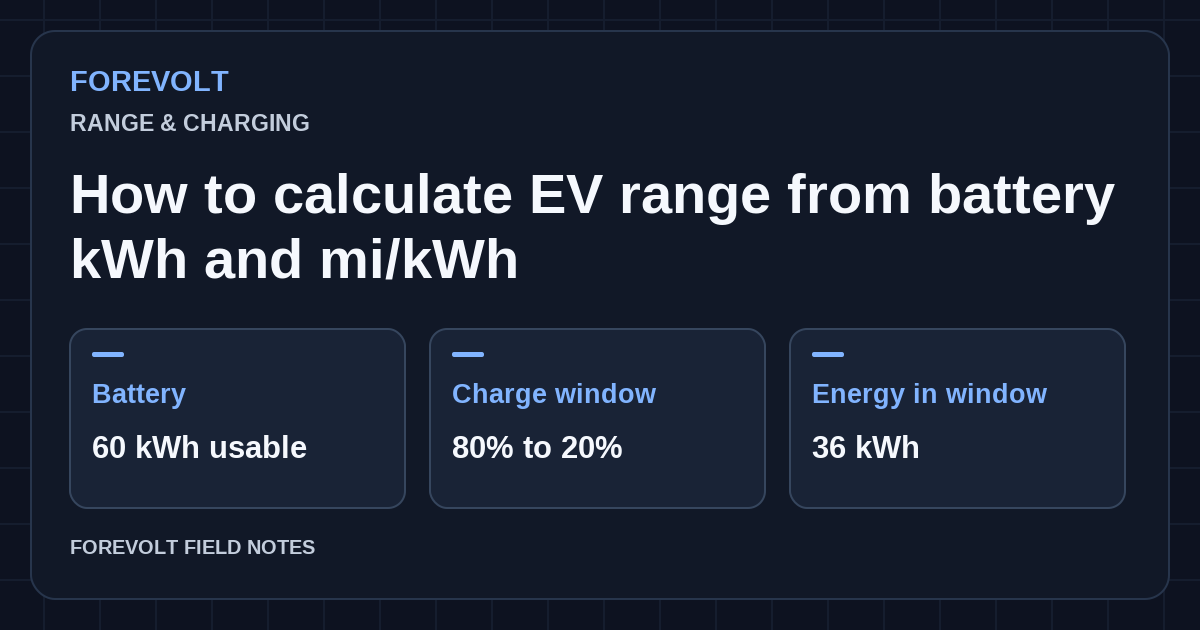
Multiply usable battery capacity in kWh by miles per kWh to get a rough full-battery range. For a real trip, multiply by the fraction of charge you intend to use as well. If you leave at 80% and want to arrive at 20%, use 0.60 in the calculation.
Start with usable capacity
Look for usable or net battery capacity in the specification for your exact car. The gross pack figure can include energy that the car holds back. For an older EV, a reliable current usable capacity figure is more relevant than the as-new figure. If you only have the original spec, say so and give the result more margin.
Calculate the range between two charge levels
Estimated miles = usable kWh × (start % − arrival %) ÷ 100 × mi/kWh.
For a 60 kWh usable battery at an illustrative 3.2 mi/kWh:
| Charge window | Energy in window | Miles on paper |
|---|---|---|
| 100% to 0% | 60 kWh | 192 miles |
| 80% to 0% | 48 kWh | 154 miles |
| 80% to 20% | 36 kWh | 115 miles |
The first two rows are comparisons, not a suggestion to drive to 0%. Actual range can change during the trip. If your display uses kWh per 100 miles, divide 100 by its reading to get mi/kWh: 25 kWh per 100 miles is 4 mi/kWh.
Does every EV need an 80% charge limit?
No. Check the handbook or charging screen for your particular car’s guidance. Tesla’s UK range guidance distinguishes between batteries with different recommended charging routines. Choose a departure charge that suits your journey and vehicle, then set an arrival margin that accounts for conditions and charging options.