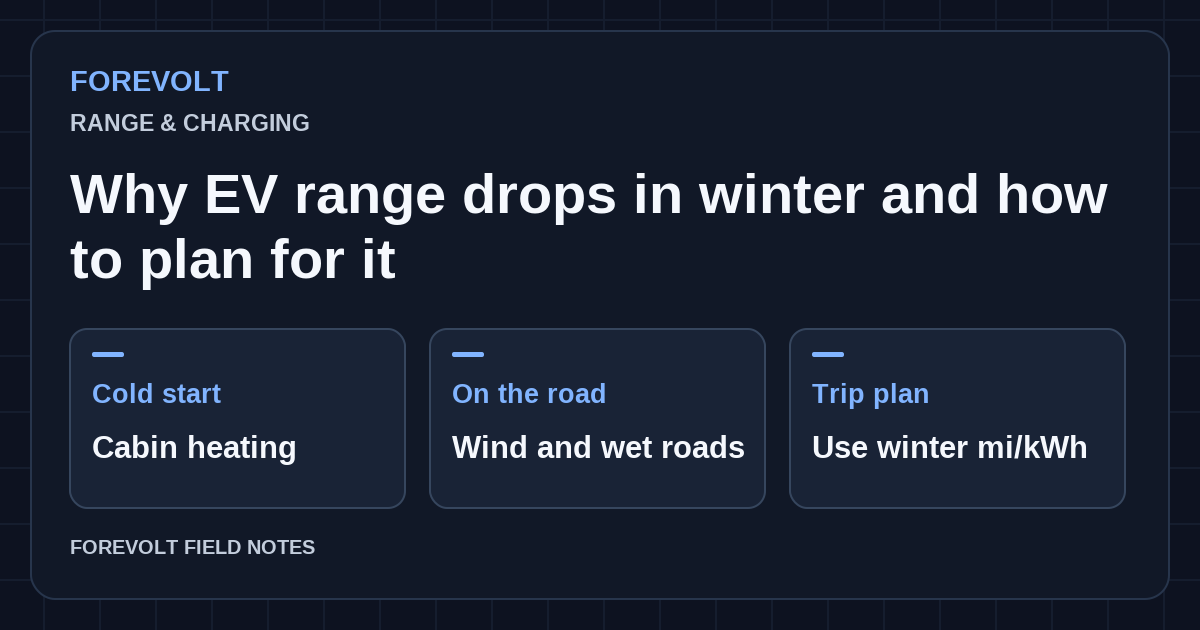
Use your recent cold-weather miles per kWh to plan a winter trip. It’s a better starting point than a fixed percentage off the brochure figure, especially if you can match the road type and weather.
Where the extra energy goes
When you set off in a cold car, some battery energy goes into warming the cabin. The car may also use energy to bring the battery up to temperature. On a five-mile school run, the warm-up takes up a bigger share of the journey than it does on a one-hour drive. Wet roads, wind and winter tyres can change consumption too. The US Department of Energy’s winter EV guide explains why preconditioning and the type of cabin heater matter.
Use the right trip average
Reset a trip meter before a representative drive. Note the outside temperature, whether the car started cold and the miles per kWh at the end. Keep a separate note for short town trips and longer motorway runs. If you use a different type of road tomorrow, don’t assume today’s number carries over.
One battery, two different plans
Suppose you have 60 kWh of usable battery capacity and you want to use 60 percentage points between departure and arrival. That gives roughly 36 kWh. At 3.5 mi/kWh it is 126 miles on paper; at 2.7 mi/kWh it is about 97. These are illustrative efficiencies for the same car, not a typical seasonal drop. Choose a charging stop comfortably within the lower estimate if the forecast is poor, and know where the next option is.
Before you leave
- If your car supports it, schedule cabin preheating while plugged in. Check the handbook for how your model handles battery preconditioning.
- Set cold tyre pressures to the manufacturer’s specification, including any loaded-car figure that applies.
- Clear frost properly and keep the demister on as needed. Visibility matters more than the efficiency reading.
- Check charger availability and adjust the plan if wind, traffic or your actual consumption changes.
A lower range reading on one cold morning does not tell you your battery has permanently lost capacity. Compare similar drives at similar temperatures before drawing that conclusion.