For an M6 run, use the efficiency from a recent motorway trip rather than the figure from your week of town driving. Better still, compare a calm-day run with a wet or windy one, then check both against the length of your next charging leg.
Why motorway range is different
Air resistance rises with speed, and a headwind means the car is working against faster-moving air even if the speedometer hasn’t changed. A roof box adds drag. An uphill leg takes energy to gain height; don’t count on getting all of it back coming down. The US Department of Energy’s EV overview explains why battery-electric cars tend to achieve better efficiency in town than on highways, and Tesla’s range guide walks through the effects of wind, speed and accessories.
Work out a single leg
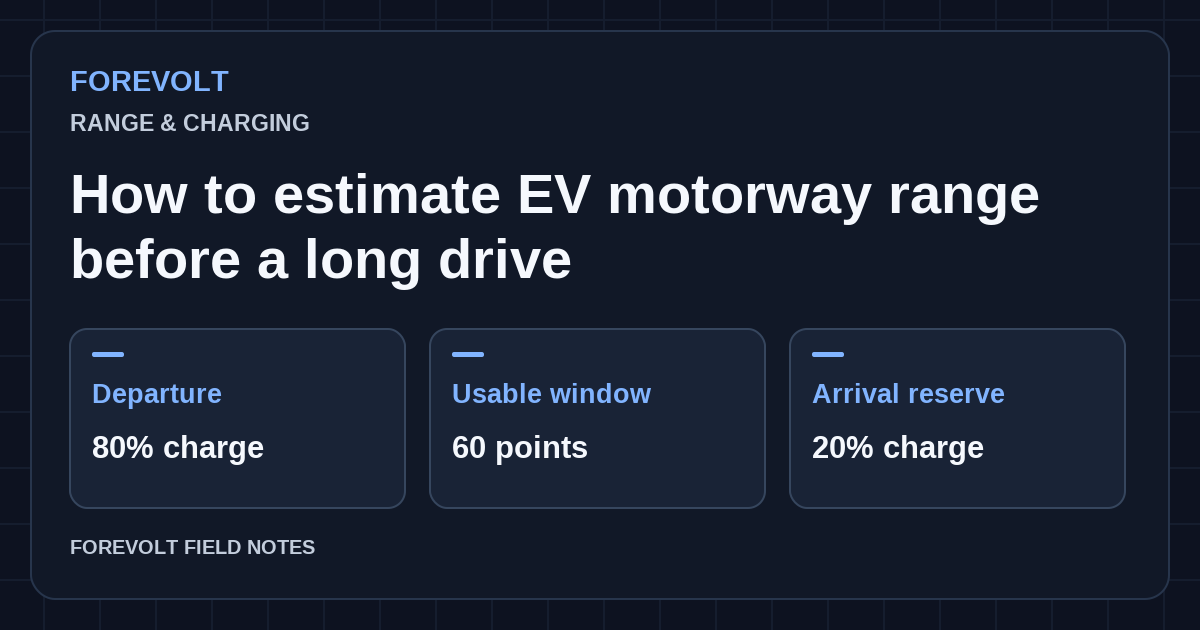
Say your EV has 64 kWh usable and you leave at 80%, aiming to arrive no lower than 20%. The 60-point window gives about 38.4 kWh. At an observed 3.0 mi/kWh that’s roughly 115 miles; at 2.5 mi/kWh it’s 96. A charger 110 miles away looks workable in the first case but pushes below the desired reserve in the second. Look for an earlier stop rather than treating either number as a guarantee.
What to check before choosing a charger
- Use the actual routed mileage, including the run off the junction and back.
- Check the charger’s connector, access hours and live status. Check a backup in the same direction.
- Plan for the reserve you want at the charger, rather than treating the battery’s last few percent as working range.
- After joining the motorway, compare the car’s live arrival estimate with your plan. Move the stop earlier if the forecast falls below your margin.
On a return trip, don’t automatically double your outbound result. The wind may reverse relative to the car, and a climb in one direction is a descent in the other.