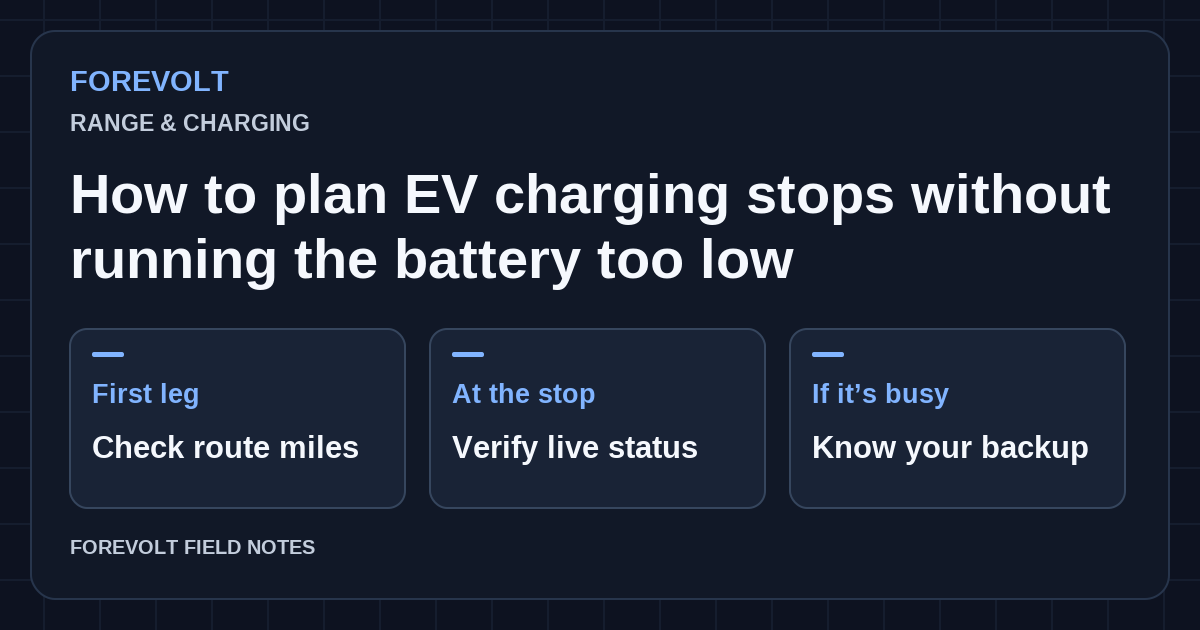
Choose where you’d like to stop before you work out the farthest you could possibly drive. A good first charger is compatible, within reach if consumption rises, and close enough to a workable alternative. That matters more than squeezing the last few miles out of the first leg.
Start with the battery you’ll actually use
Suppose the car has 58 kWh of current usable capacity. You’re leaving at 90% and want to arrive at the first stop with at least 20%. That leaves a 70-percentage-point window, or 40.6 kWh. At 3.1 miles per kWh the rough budget is 126 miles. If the car only manages 2.6 miles per kWh on the day, it drops to about 106 miles. In that example, a stop around 90 miles makes more sense than one at mile 120. The percentages are examples, not recommended limits for every car or route.
Pick a reserve that gives you enough charge to reach a viable alternative if the first site is down or full. Allow more margin when chargers are sparse, the weather is uncertain or the car is new to you. Treat the reserve as a point to make a decision before reaching it, not energy to spend just because it appears on the screen.
Give every long leg a named backup
- Check connector type and whether the site is reachable on your carriageway without a long detour.
- Check the operator’s availability, opening hours and payment instructions. Look for more than one usable charger where you can.
- Work out the distance to the backup from your decision point, not only from the main charger. An alternative behind you may be the better option before you pass it.
- Include the last leg. If destination charging isn’t confirmed, leave enough to get to an open charger afterwards.
Change the plan before the margin disappears
Use the car’s predicted arrival percentage and compare it with your reserve. If it falls towards the reserve early, reroute to the earlier option at the next safe opportunity. Charge for the next leg plus its own reserve; use the car’s charging and journey advice rather than assuming the power printed on the charger is what you’ll get throughout.
Zapmap’s public charging help explains connector and status filters; its UK route planner can help locate stops. Check live status before leaving and again when stopped if the plan changes.
Why actual charging speed can be lower than the number on the unit.