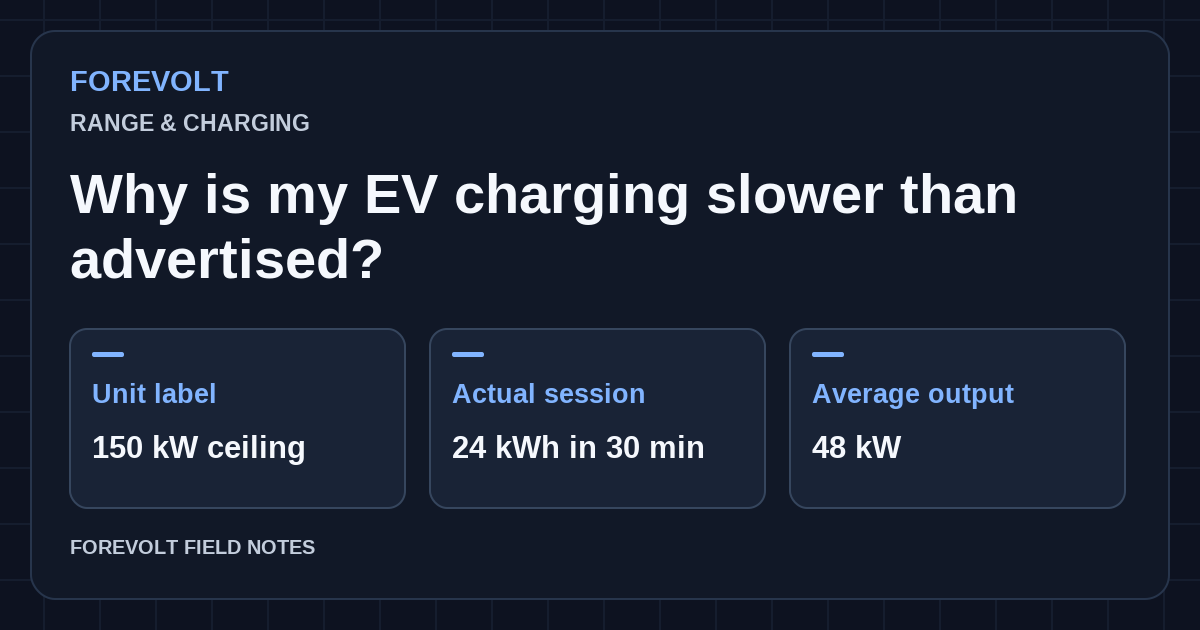
Plug in at a 150 kW charger and see 58 kW? The number on the unit is a ceiling. The car can ask for less, and the charger may not be able to deliver its full rating to every vehicle or bay.
Check what the car can take
Find the maximum DC rate for your exact battery and trim in the handbook or manufacturer specification. If it says 100 kW, a 150 kW charger will not make the car accept 150 kW. Peak power, if you reach it, may last only a short time. The speed at each point through a session is called the charging curve.
Notice when the session slows down
A cold battery may start slowly and pick up speed as it warms. A battery that is already fairly full commonly charges more slowly; the point where power starts to fall depends on the car. If the handbook shows how to precondition the battery for fast charging, use that procedure rather than assuming a warm cabin means a warm battery.
Look at the charger as well
Some units split power across two plugs; a busy site can also have a shared limit. Check the station display and the operator app. Charger cable current and the battery's voltage can also constrain what the pairing delivers. GRIDSERVE explains these limits on its own network.
Compare average power, not the biggest number you saw
If the session shows 24 kWh delivered in 30 minutes of actual charging, the average was 48 kW. Save the session summary, starting charge and conditions. If you see unusually low rates across compatible chargers with a warm battery and a similar starting charge, ask the network or the car manufacturer to investigate. One low peak on one session does not diagnose the battery.
For a stop-by-stop approach, see how to plan an EV road trip.